


Savate, also known as Savate Boxe Française, is a uniquely French combat sport that blends foot techniques, boxing punches, and a long process of cultural refinement. Its history reflects the transformation of raw street fighting into a regulated martial art and modern sport.
Origins: Popular Combat in the 18th and Early 19th Centuries
The roots of Savate can be traced back to 18th-century France, where physical confrontations were common among sailors, dock workers, and urban populations. Early forms of Savate relied mainly on kicks, often delivered while keeping balance by placing one hand on the ground—a method notably used by Mediterranean sailors.
Two regional practices emerged:
- In southern France, a kicking system called chausson
- In northern France, savate, which added open-hand strikes
These methods were pragmatic, informal, and strongly associated with the working classes.
Codification and Birth of Boxe Française (1820–1850)
A decisive turning point came in 1820, when Michel, known as “le Pisseux”, opened the first Savate training hall in Paris. Savate began to attract not only workers but also aristocrats and intellectuals.
After suffering defeat against an English boxer in 1830, Charles Lecour studied English boxing and combined punches with traditional Savate kicks. This synthesis gave birth to Boxe Française, a more complete and effective combat system.
Scientific Structuring and Sporting Recognition (1870–1914)
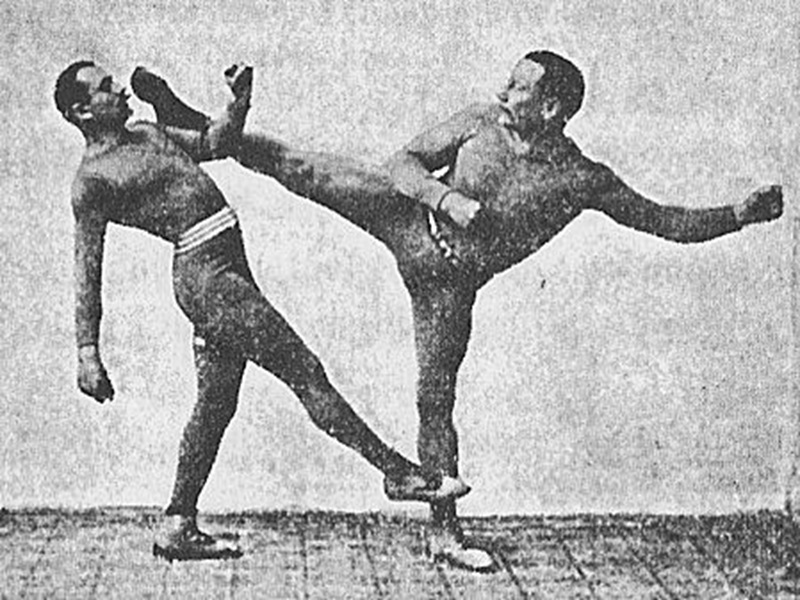
The discipline was fully systematized by Joseph Charlemont, who published the first scientific treatise on Savate in 1877, establishing precise techniques, guards, and movements. His son, Charles Charlemont, further elevated the discipline through international victories, notably defeating English champions at the turn of the 20th century.
By 1900, Savate enjoyed major popularity in France and abroad and was practiced as both self-defense and sport.
Decline and Revival (1914–1960s)
World War I marked a sharp decline. Professional English boxing gained dominance, and Savate nearly disappeared. Its survival depended on a small number of dedicated practitioners.
A revival began in the 1960s, driven by a new generation committed to restoring Savate as a modern sport. In 1965, a national governing body was created, leading to renewed growth, competitions, and structured training.
Modern Savate: A Family of Disciplines
From the late 20th century onward, Savate expanded into multiple regulated practices:
- Savate Assaut (controlled, technical)
- Savate Combat (full-contact)
- Savate Défense (self-defense)
- Savate Forme (fitness and well-being)
- Canne de Combat & Bâton (armed disciplines)
In 2000, the official name Savate Boxe Française was adopted, reinforcing its cultural identity. In 2015, Savate was officially recognized as part of France’s Intangible Cultural Heritage.
Conclusion
Savate is far more than a combat sport. It is the result of two centuries of social, cultural, and technical evolution, transforming popular violence into a disciplined art of movement, strategy, and self-mastery. Today, Savate stands as a living expression of French martial tradition—elegant, effective, and deeply rooted in history.