Savate News

Savate evolution

February 28, 2008 250 news.views

If punch and kick combat goes as far back as Ancient times when fist-fighting was present, the first methods of combat from whence Savate originated date back to the 18th century. Having started in the streets, its origins are not very noble. In the S

 
If punch and kick combat goes as far back as Ancient times when fist-fighting was present, the first methods of combat from whence Savate originated date back to the 18th century. Having started in the streets, its origins are not very noble.

In the South of France they had "Chausson" (Slipper): a combat sport where only the feet were used. In the North, we preferred "Savate" (Old shoe) where we sought to hit with both feet and open-hands. These methods did not have a very good reputation as the main players were the louts.


Michel Casseux was the first to standardize Savate. In 1820, he opened a sports hall that attracted the VIPs of that era, including Charles Lecour. One might say that it was he who created French boxing in 1840. Indeed, he combined "Chausson" with boxing. 

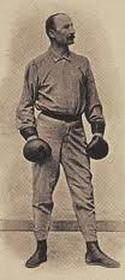
 Around 1848, Joseph Charlemont, a fencing master who excelled at swordstick, fencing and stick,
Joseph Charlemont
 started learning French boxing. Thanks to his intelligence and his physical skills, he quickly got himself noticed in the world of French boxing.

In 1862, Charlemont had a son, Charles, whom he taught from a very young age. Later, the turmoil caused by the war pushed Joseph and his son to emigrate to Belgium where they introduced French boxing. They standardized various techniques, regulated the matches and published the first book on French boxing in Brussels. This is still today the basis of modern French boxing.

Toward the end of the 19th century, Joseph Charlemont, back in France, created the "French Boxing Society". Charlemont made a big impact throughout his era as he was an outstanding master and an excellent fighter. Above all, he managed to take a lout's weapon and turn it into a defense sport for all.

At the beginning of the 20th century, more than 100,000 people were taking part in French boxing.

However, the increasing popularity of open-air sports, the tendency toward Olympic sports, the absence of a federal structure as well as people's interest for spectator sports caused a decline in French boxing and, at the dawn of the second world war, only 500 followers were still taking part in the sport.

In 1922, the first national federation was created in Belgium: "The Royal Belgian League of French Boxing".
 

 Around 1965, the mandatory teaching of French boxing to students in Phys. Ed. class and the association of the federation with the Judo federation brought French boxing back to life.

Indeed, we can refer to the years after 1975 as being the period of rebirth for French boxing. 


151

news.share